Style Guide

Masonry-Style Kitchens: Achieving the Look with Italian Furniture

A chtisti kitchen is built on site out of masonry. We don't build — we design the same character in Italian furniture. Here is what changes and what stays the same.

MobilCasa · Neo Psychiko, Athens

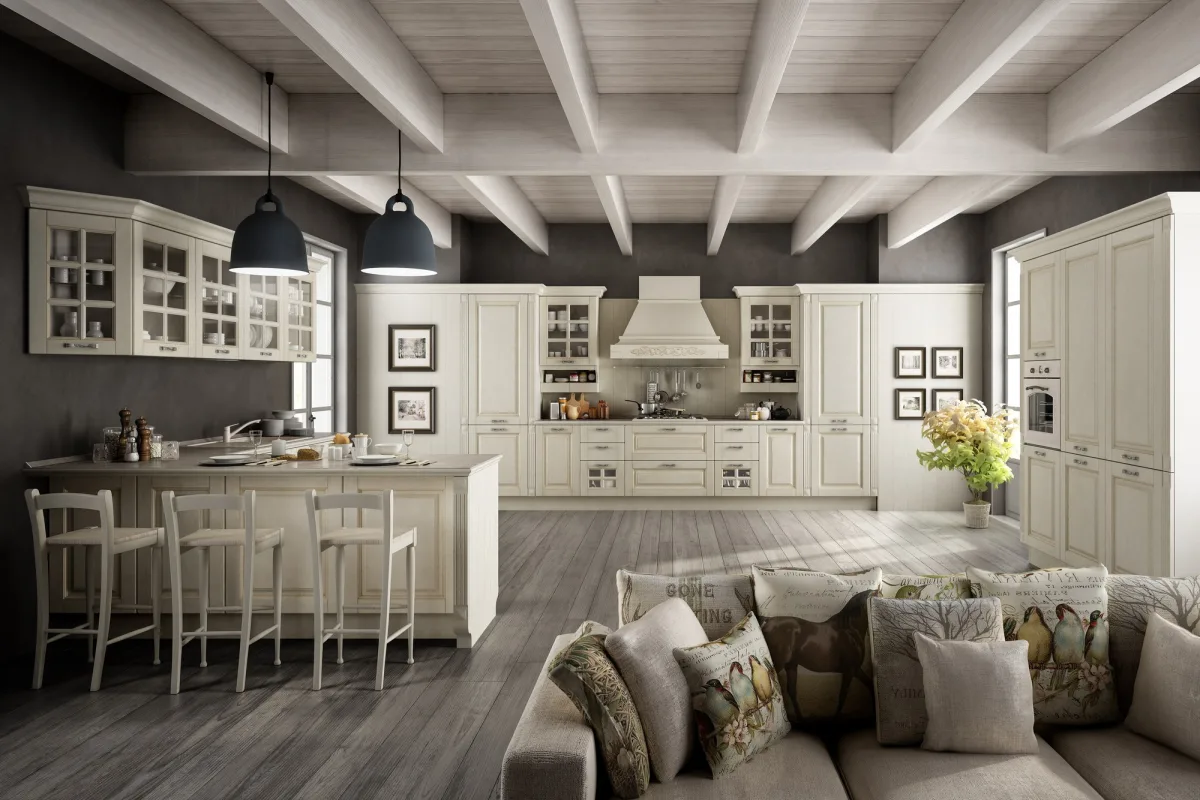
Classic Sira Sofia kitchen in a patinato finish, with a rendered hood canopy and cornices
Sira Cucine · Sofia in patinato — the rendered hood canopy and the cornices produce the masonry-style reading, in furniture.

In short

A masonry-built kitchen — chtisti kouzina in Greek — is constructed on site from cement board, brick or concrete and then clad in tile, polished cement render or plaster. MobilCasa does not build masonry kitchens. What we do is reproduce the same character — the heavy, permanent, handmade feel — in bespoke Italian furniture.

  • The character comes from six design decisions: framed doors, hand-applied patina, cornices with a substantial hood canopy, recesses and open shelving, dressers and glazed units, and a continuous worktop.
  • Four models from the houses we curate do it: Gentili Romantica, Febal Sinfonia and Febal Origina Telaio Legno — all installed in the showroom — plus Sira Sofia — not installed; we present it through material and finish samples, catalogues and personalised design.
  • Furniture wins on lead time, on internal mechanisms and on the ability to change things later; masonry wins on monolithic mass and on freedom of shape.
  • These are not the same thing and we don't present them as the same. They are two different routes to a similar image, each with its own advantages.

01

What a masonry-built kitchen actually is

The term gets used loosely. It is worth separating what people mean by it.

A masonry-built kitchen is construction work. The worktop, the base units and often the tall units are built on site from cement board, brick or reinforced concrete, then clad — tile, polished cement render, plaster or stone. The cupboards are recesses inside that structure; doors, drawers and shelves are added afterwards, usually by a joiner.

It is a real and respected technique with a long tradition in Greece and around the Mediterranean. It suits holiday houses, stone-built homes and semi-outdoor spaces particularly well, where monolithic appearance and hard-wearing surfaces genuinely matter. We have nothing against it. It simply isn't what we do.

What we see in the showroom is that most customers who ask for a masonry kitchen are not asking for the method — they are asking for the image: weight, continuity, handmade texture, nothing that looks industrial. That image can be achieved in furniture too, and usually with fewer compromises in daily use.

02

Masonry construction or Italian furniture?

The real differences, without the marketing. Neither column is "the right one" — it depends on the space and on what matters to you.

AspectMasonry constructionBespoke Italian furniture
How it is madeOn site, by a building crew. Building, cladding, waterproofing.Manufactured to exact dimensions in the factory, then installed in your home.
TimeDepends on the crew and on drying times; the stages run in sequence and the room stays open for the duration.4–12 weeks in production, with installation usually taking 1–3 days. Work in the room is largely confined to the strip-out and installation days.
How the cost is arrived atMaterials + crew day rates + cladding + joinery for doors and drawers. It accumulates as the work progresses.A single quotation after measurement: fronts, carcasses, mechanisms, worktop, installation. One figure, before anything begins.
MoistureMasonry itself is not afraid of water, but the waterproofing around the sink and the grout lines need correct execution and upkeep.Carcasses are water-repellent board with sealed edges; worktop and sink are engineered as one system at the factory.
Maintenance & repairVisible surfaces clean easily. Damage to cladding or grout is repaired in place by a tradesman.A single door, hinge or drawer is replaced individually, with a genuine spare from the manufacturer, years later.
Flexibility & changeThe structure is permanent. Changing the layout means building work.The layout is settled on the drawing before ordering, and fronts can be changed in colour or style later.
Appliance integrationRecesses are built to the appliance's dimensions. Replacing it later with a different size is difficult.Tall and base units follow European built-in standards, so an appliance can be swapped without alterations.
Internal mechanismsShelves and drawers are added by a joiner; the quality of the runners depends on what is specified.Italian and German mechanisms as standard: full-extension drawers, soft close, corner units, internal organisers.
Moving houseIt stays. It is part of the property.It can be dismantled, moved and adapted to a new space.
WarrantyCovered by the crew that carried out the work.Manufacturer warranty of at least 2 years (many houses extend it), with spare parts and technical support from us.

If what you want is the monolithic structure itself — one body of masonry, with free curves and a fireplace beside it — then masonry is the right route and we will tell you so plainly. If what you want is the image and the feel, with the certainty of a single quotation and mechanisms that work every day, furniture does the job.

03

The six things that create the built-in character

It isn't the material that makes a kitchen read as masonry-built. It is six design decisions — and all of them exist in the Italian models we curate.

Detail of framed doors on a Febal Casa Origina Telaio Legno kitchen, with a visible frame profile and a continuous worktop

Framed doors

The frame around the centre panel casts a shadow. That shadow is what reads as thickness and weight — the exact opposite of a flat, smooth slab front.

Sira Sofia kitchen in a decapé finish with visible wood grain

Patina & decapé

A hand-applied finish lets the grain of the wood show through and never repeats identically. That small irregularity is what reads as handmade.

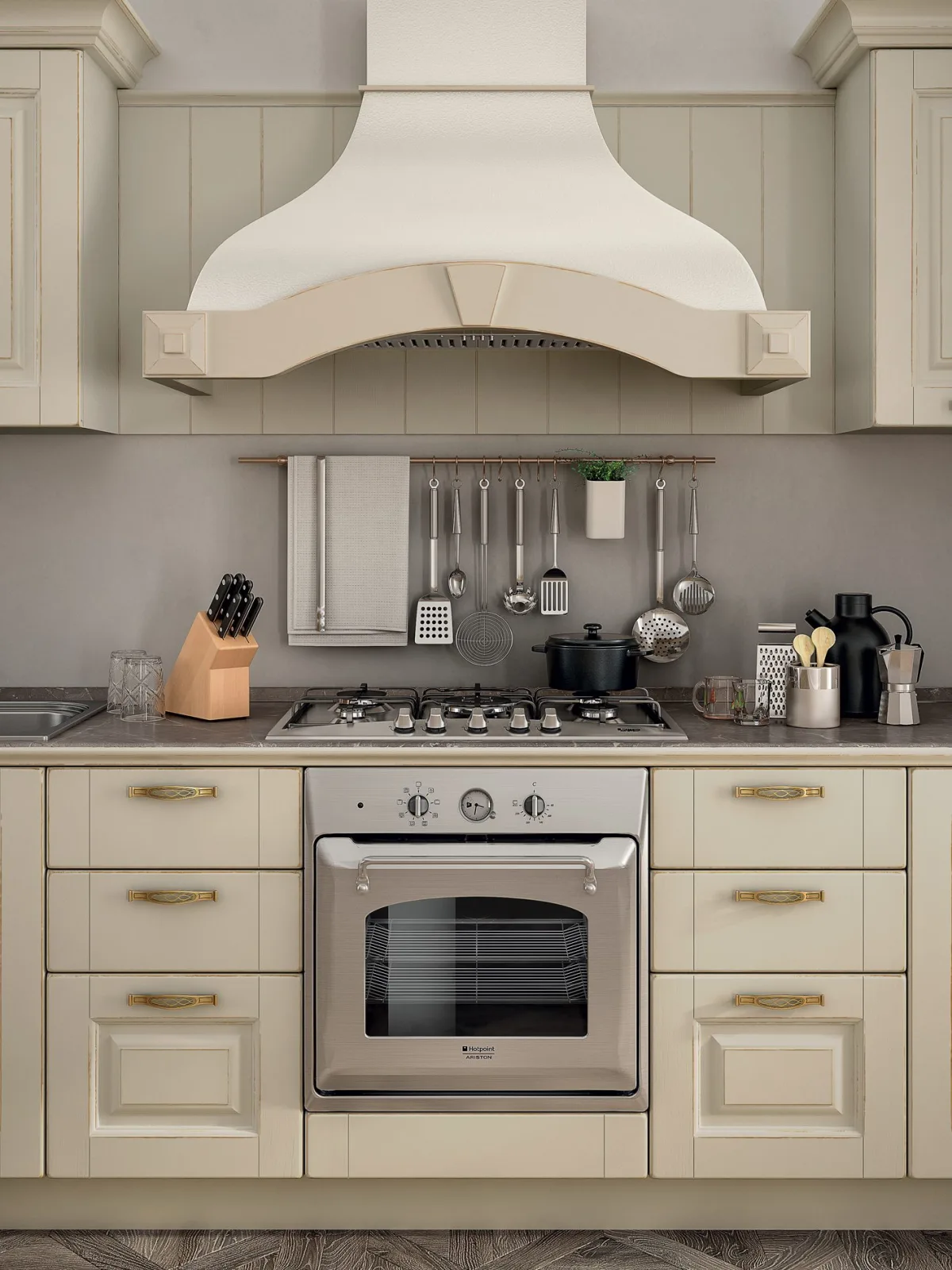
Chimney-style extractor hood with cornice, Sira Sofia patinato kitchen

Cornices & hood canopy

A substantial chimney-style hood and a cornice running along the top of the tall units close the composition into the wall, the way a built structure would.

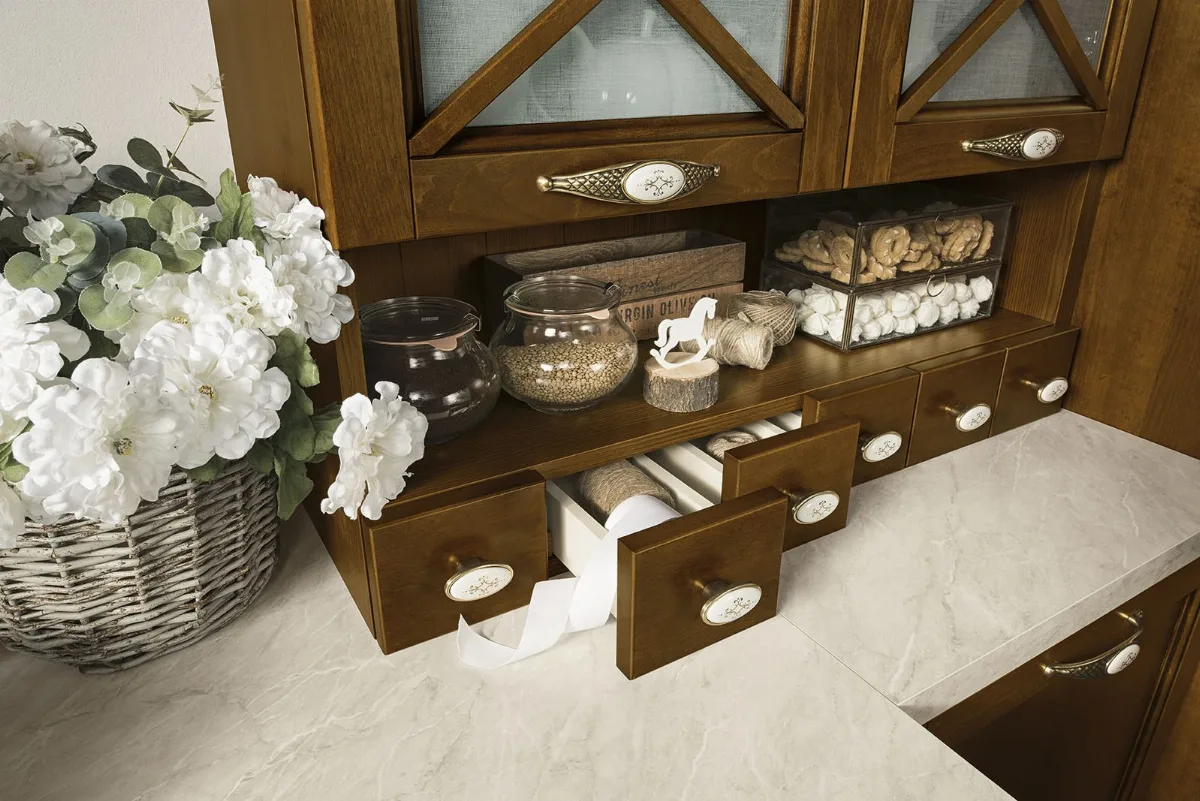
Open recessed shelf and glazed unit in a walnut Febal Casa Sinfonia kitchen

Recesses & open shelves

One open opening inside the run — for jars, cookbooks or firewood — breaks the line of closed doors and reads like a built recess.

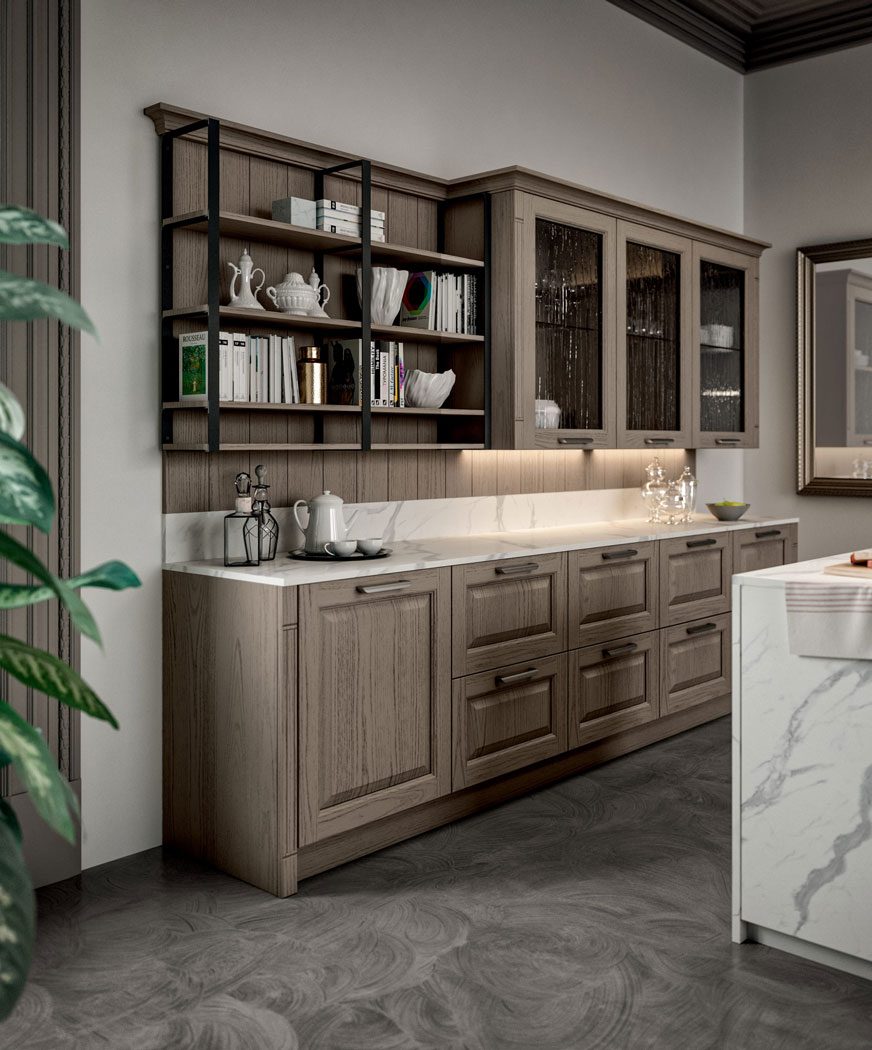
Dresser with open shelving in a Gentili Romantica kitchen

Dressers & glazed units

A lower, deeper body with a glazed door beside the main run does the job of the cupboard that would have been built into the wall of an old village house.

Corner classic kitchen composition by Gentili Romantica with a continuous worktop

A continuous worktop

A worktop with no visible joins, turning the corner and rising as an upstand, gives the monolithic continuity that matters more than any other single detail. See our worktops guide.

04

Four models that do it

This isn't theory — but nor is it all on display. Romantica, Sinfonia and Origina Telaio Legno are installed in our showroom. Sofia is not: we present it through material and finish samples, catalogues and personalised design. The photographs on this page come from the manufacturers' own collections, not from our showroom floor.

Gentili Cucine Romantica kitchen in an open-plan room with an island

Gentili Cucine

Romantica

One of the three you can see standing in our showroom. Lacquered or semi-solid, with cornices, glazed units and a dresser — the gentlest, most urban reading of the classical, for an Athens apartment that does not want the heavy, rustic version.

See the Romantica compositions →
Febal Casa Sinfonia kitchen in walnut, with beams, glazed units and a rendered hood canopy

Febal Casa

Sinfonia

The second model standing in our showroom. Walnut with a deep frame profile, latticed glazed units and a rendered canopy over the hob — the most rustic and warmest reading of the four, for a country house, or a home that wants the kitchen to look as though it had always been there.

See the Sinfonia compositions →
Febal Casa Origina Telaio Legno kitchen in Grigio Ardesia, with framed doors on base units, tall units and glazed cabinets

Febal Casa

Origina Telaio Legno

The third model standing in our showroom — and the most contemporary reading of the framed door. A frame on every front, from the base units to the tall units and the glazed cabinets, but in a calmer, more urban register: slate grey, marble and straight lines. For anyone who wants the frame without the rustic reading.

See the Origina Telaio Legno compositions →
Sira Cucine Sofia kitchen in natural walnut essence, with a deep door frame and cornice

Sira Cucine

Sofia

The most masonry-inspired of the four. It is not installed in the showroom; we present it through material and finish samples, catalogues and personalised design. Solid wood, a deep frame profile and a patina worked by hand — in patinato, decapé and natural essences. This is the model we reach for when a customer wants the kitchen to look as though it had always been there.

See the Sofia compositions →

All four belong to the wider family of classic kitchens; Sofia is also solid wood.

05

How we design it with you

Practical decisions that get made on the drawing, not during installation.

Heights and depths

This character needs height. Tall units run to the ceiling with a cornice, so no dust gap is left above them, and the worktop often sits 2–4 cm higher than standard because a heavy front visually lowers it. All of that is set at the measurement stage.

Appliance integration

In a kitchen with this character you don't want the appliances shouting. The oven and steam oven go into a tall unit behind a framed door, the fridge and dishwasher are integrated behind fronts matching the rest, and the extractor hides inside the canopy. The only thing left visible is the hob — and even there, Invisacook can make it disappear under the worktop.

Moisture and the sink

The most vulnerable point in any kitchen — masonry or furniture — is the base unit under the sink. In the Italian carcasses we use water-repellent board with sealed edges and an aluminium tray in the sink base. For a holiday house, or a space that stays shut through the winter, this is a design decision rather than a detail.

Worktop and upstand

The monolithic feel is won here. A quartz or sintered-stone worktop with an upstand in the same material and no join does more than any front. Solid wood gives the warmest version but asks for more care. The options are in our worktops guide.

Lighting

Deep cornices and framed doors create shadow — which is the point — but they need light under the wall units for the worktop to work. Concealed linear lighting in a warm colour temperature, never cool.

06

Five mistakes we see

All of them are fixable on the drawing. None of them is fixable after installation.

  • A framed door in too small a roomThe frame eats width and casts shadow. In a kitchen run under 2.5 metres, a heavy classical front closes the space in rather than giving it character. A slimmer frame profile, or Romantica, works better there.
  • Patina on every surfacePatina works as a contrast. When it goes on the wall units and the island and the dresser, it stops doing its job and the result reads as themed rather than authentic.
  • Modern appliances left on showA stainless fridge next to a patinated front undoes the work of the whole composition. Integration is not a luxury here, it is a precondition.
  • A worktop with visible joinsTwo worktop pieces joined in the middle of the run break exactly the continuity we are after. It is solved by getting the dimensions right before ordering.
  • Leaving the ceiling openTall units that stop 30 cm short of the ceiling make the kitchen look like furniture leaning against a wall. The cornice that closes it upwards is what produces the built-in reading.

07

How the cost is arrived at

We don't quote without measuring, because any figure before that is a guess.

In masonry construction the cost accumulates in stages: masonry materials, crew day rates, cladding, waterproofing, and then joinery for doors, drawers and shelves. Each stage is invoiced as it comes, so the final total becomes clear at the end.

With Italian furniture the cost is fixed once, before anything starts. After the measurement and design, the quotation covers fronts, carcasses, mechanisms, worktop and installation. What drives it is the front material, the finish (patina and decapé are hand processes and cost more than a sprayed lacquer), the worktop material, the number of tall units and the internal mechanisms.

The ranges and the relative scale by material are set out in our kitchen prices guide.

08

Frequently asked questions

Do you build masonry kitchens?

No. MobilCasa does not undertake building work and does not construct kitchens out of masonry. We design and install bespoke Italian kitchen furniture, which reproduces the same classical, substantial character.

Can furniture really look like a masonry-built kitchen?

It can reproduce the character — the weight, the shadow, the handmade texture, the continuity of the worktop. It is not the same thing, though, and we don't present it as the same: masonry is monolithic and permanent, furniture is assembled and reversible. In practice, from a metre away the difference is hard to read; from ten centimetres it is obvious in both.

Which model comes closest?

Sira Sofia in patinato or decapé, because it combines solid wood, a deep frame and a hand-applied finish — though we hold it as samples. Of the ones actually standing in the showroom, Febal Sinfonia comes closest, with its walnut, beams and glazed units. Gentili Romantica follows, and Febal Origina Telaio Legno is the most contemporary reading of the frame.

Will it survive a holiday house that stays shut all winter?

With the right specification, yes. We use water-repellent board with sealed edges, an aluminium tray in the sink base, and a quartz or sintered-stone worktop rather than solid wood. Tell us at the start that the house stays closed — it changes the specification, not the design.

How long does it take?

Production in Italy usually takes 4–12 weeks, depending on the house and the finish, and installation is usually completed in 1–3 days. Work in the room is largely confined to the strip-out and installation days.

I already have a masonry kitchen. Can you replace it?

Yes, and it is one of the jobs we do most often. The existing structure is taken out by a building crew and we measure the clear space. In some cases we keep the masonry base and fit a new worktop and new fronts on top of it — we judge that at the measurement.
Bring us your space

Come to the showroom in Neo Psychiko with your dimensions, or a photograph of the kitchen you have now. You'll see Romantica, Sinfonia and Origina Telaio Legno installed, see Sofia through material and finish samples and catalogues, and we'll tell you plainly whether the look you want can be done in furniture or not, and we'll design it with you. The design and the measurement come with no obligation.

Book an appointment

See also