The completely invisible cooking zone: hob and extractor inside the worktop

In short: the completely invisible cooking zone combines two solutions: the Invisacook induction hob under a sintered stone or porcelain worktop 12–20 mm thick, and a worktop extractor that rises while you cook and sinks into the worktop when you finish, like the Italian Falmec Level Invisible. When you are not cooking, neither hob nor extractor is visible. We confirm in the design study whether the combination suits your kitchen.
In recent years the kitchen has been slowly shedding whatever «weighed it down»: knobs, visible appliances, frames. Two things held out. The hob, a black window cut into the worktop. And the extractor, a chimney above the island.
Today both can disappear from view. Below we explain how, what has to be decided early, and what we confirm before anything else.
Part one: the hob you cannot see
The Invisacook invisible hob, from Bunnell, Florida, is fitted under the worktop with a rail or clip system, like an undermount sink. The electromagnetic field passes through the stone and heats only the cookware. There is no cut-out, joint or grid: you place the pan on the worktop and cook.
- The worktop has rules. It needs sintered stone or porcelain 12–20 mm thick. First choice is Ascale sintered stone, second is Caesarstone Porcelain. Quartz, marble, laminate and wood are not suitable.
- The unit is just 5 cm thick, so it does not steal drawer space.
- From 1 to 5 zones. One zone for an island or a prep worktop, up to a full five for a large kitchen.
- The control is hidden too. The controller goes in a drawer, on the splashback or on the edge of the worktop, and there is also a Wi-Fi app.
A silicone InvisaMat always goes between the cookware and the stone, one for each zone. And something we tell every customer from the start: during extended cooking the surface warms up gradually. When the unit is off, the worktop stays cool.
Part two: the extractor that sinks into the worktop
Once the hob is hidden, the ceiling extractor is the only visible «machine» left in the kitchen. The answer is a worktop extractor, which draws the steam where it is created instead of waiting high above. One example is the Level Invisible from the Italian manufacturer Falmec: we can design it together with Invisacook, once we have confirmed compatibility in the design study.
What it does, according to the manufacturer
- It rises and sinks. Up/Down lift system with height adjustment. When it lowers into the worktop, it literally disappears from view, according to the manufacturer.
- It can be clad in the worktop material. The top panel can be made from the same material as the kitchen worktop, so when it sinks down it essentially disappears.
- It also works with a hidden induction hob. It is stated to be compatible with gas, ceramic and induction hobs, including fully recessed, hidden induction hobs.
- Quiet brushless motor, with front or rear installation.
- Light that changes tone. Dynamic Light LED, from warm 2700K to cool 5600K.
- Simple control. Touch on the front panel, Dialogue system, optional remote control and automatic switch-off timer.
- Easy-care filters. A removable, washable metal grease filter and an optional Carbon.Zeo Microtech regenerating filter.
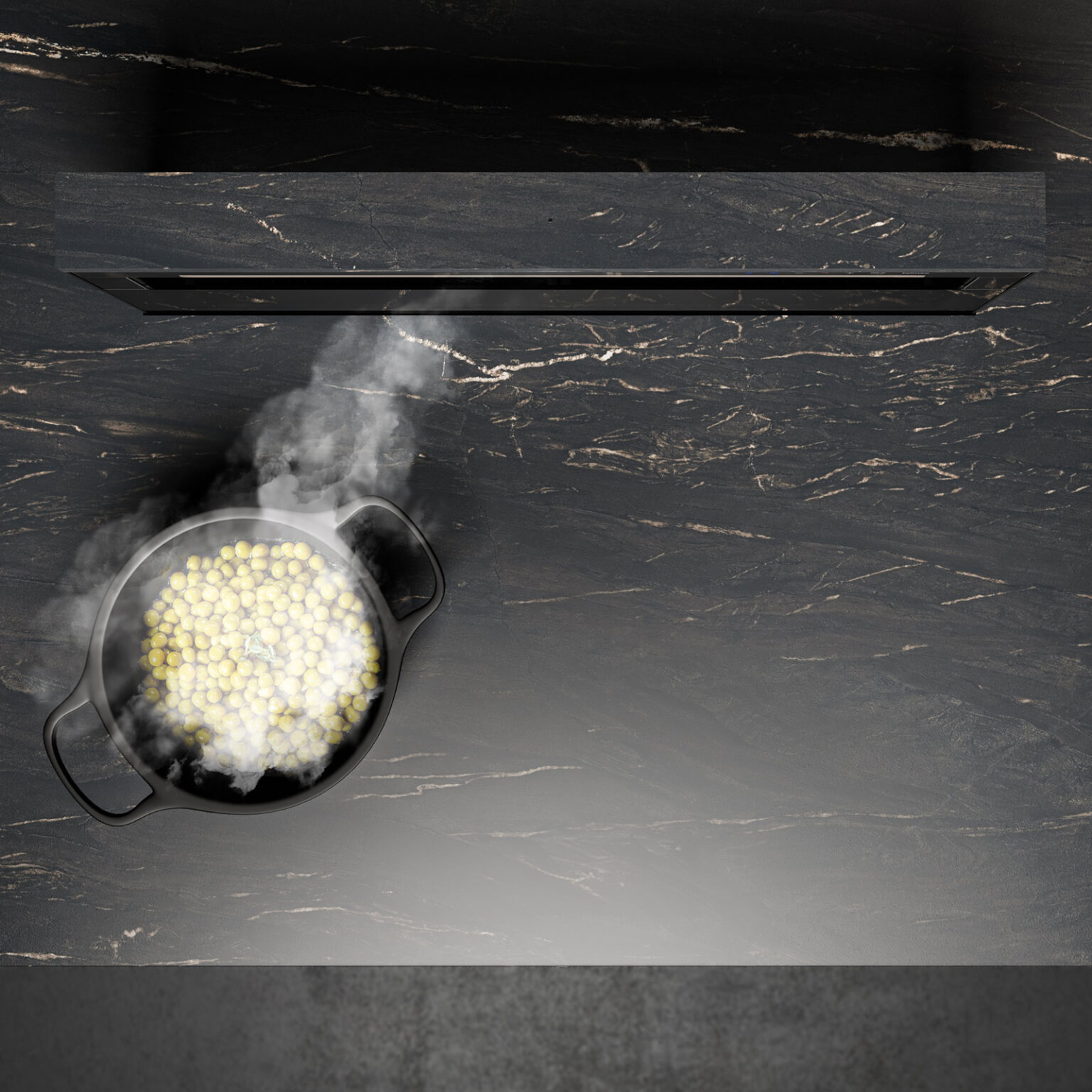
For the 90 cm version with an customisable top panel, the manufacturer states a performance of 800 m³/h.
Together: a cooking zone that disappears
Imagine an island made of a single slab of sintered stone. You place the pan on the stone and the extractor rises beside it. When you finish, you lower it and wipe down. What remains is a continuous surface from edge to edge, with no black glass and no chimney above your head. The island becomes a worktop again: for prep, the morning coffee, the children's books.
In an open kitchen, joined to the living room, this matters more than anywhere else. The eye falls on a piece of furniture and a piece of stone, not on appliances. The kitchen looks like a room of the home, not a workspace.
What we confirm in the design study, before anything else
Here we are upfront, because the combination is new and needs to be done in the right order.
- The panel and the worktop. The manufacturer says the panel can be made from the worktop material. Whether it can be the same Ascale or Caesarstone slab, at the 12–20 mm thickness Invisacook requires, we confirm for your own kitchen.
- The space under the worktop. The hob unit, the lifting mechanism and the motor share the same cabinets. The clearances are designed together with the drawers, not afterwards.
- The specific combination. Falmec speaks in general terms about hidden induction hobs and does not name Invisacook. We check the compatibility of the pairing for each kitchen.
- The air route. Where the air will go and which filter will be needed is decided together with the floor plan.
- The installation. Invisacook requires professional installation by an electrician and a worktop fabricator, and our team coordinates the whole process.
The other route: hob and extraction in one, with Bora
Not everyone wants the hob hidden. If you like to see where you cook, the Bora hobs with integrated extractor solve the same problem differently: the steam is drawn downwards, at cooking level, and the ceiling extractor goes here too. Bora is one of our seven partners and has a fixed place in the kitchens we design.
| Invisacook + worktop extractor | Bora | |
|---|---|---|
| Hob | Under the stone, not visible | On the worktop |
| Extraction | Rises from the worktop, sinks back into it | Integrated in the hob, downwards |
| Worktop | Sintered stone or porcelain 12–20 mm | Chosen together with the kitchen |
| When you are not cooking | Continuous stone | One single hob with extraction |
Both routes take the extractor off the ceiling. We choose the right one for you together, based on the space and the way you cook.
Why it goes into the design from day one
The invisible cooking zone is not an appliance you add at the end. The worktop, the cabinets below, the electrics and the air route are decided together. That is why we work in the order we do: visit, design, moodboard, quotation, installation, after-sales. For the materials, see also the guide to kitchen worktops.
What is a worktop extractor?
An extractor fitted inside the worktop, next to the cooking zone, that draws the steam where it is created, instead of a chimney from the ceiling. The Falmec Level Invisible rises when you need it and sinks into the worktop.
Can a worktop extractor be combined with Invisacook?
Falmec states that the Level Invisible also works with fully hidden induction hobs, without naming Invisacook. The compatibility of the combination, the panel thickness and the clearances under the worktop we confirm in the design study for your kitchen.
What worktop does the invisible cooking zone need?
For Invisacook, sintered stone or porcelain 12–20 mm thick: first choice Ascale, second Caesarstone Porcelain. Quartz, marble, laminate and wood are not suitable.
Bora or an invisible cooking zone?
Both remove the ceiling extractor. Bora combines hob and extraction in one appliance on the worktop. The invisible zone hides both inside the worktop. We choose together, based on the space and the way you cook.
Do you want a kitchen where neither the hob nor the extractor can be seen? We design your kitchen with you, and often the whole home. Book an appointment at our showroom, 267 Mesogeion Avenue, Neo Psychiko, or call us on +30 210 674 8332.
Shall we design it together?
Come to our showroom in Neo Psychiko — we design and cost your kitchen together. The 3D design for the presentation is free.
Book an appointment267 Mesogeion Avenue, Neo Psychiko, Athens · +30 210 674 8332