Minimalist architectural vs Tuscan kitchen

In short: the minimalist architectural kitchen hides: flat doors without handles, built-in appliances, matt surfaces and a clear worktop. The Tuscan kitchen shows: wood or patinated lacquer, framed doors, earthy colours such as ochre and terracotta, stone and handles with character. Which one suits you depends on the space, how you cook and how much you want to see around you. We design both with you, using ranges from the Italian houses we curate, and we often end up with something in between.
In the showroom we often hear the same question, with two images on a phone: a kitchen that looks like part of the wall and a kitchen that recalls a farmhouse in the Italian countryside. Both are Italian. But the difference is not only aesthetic. It changes where you store things, what stays on the worktop, how the materials age and how the kitchen ties in with the rest of the home.
Below we set the two styles side by side, with the ranges from the houses that genuinely suit each, and with two kitchens we designed together with our clients.
Minimalist architecture: the kitchen that becomes part of the space
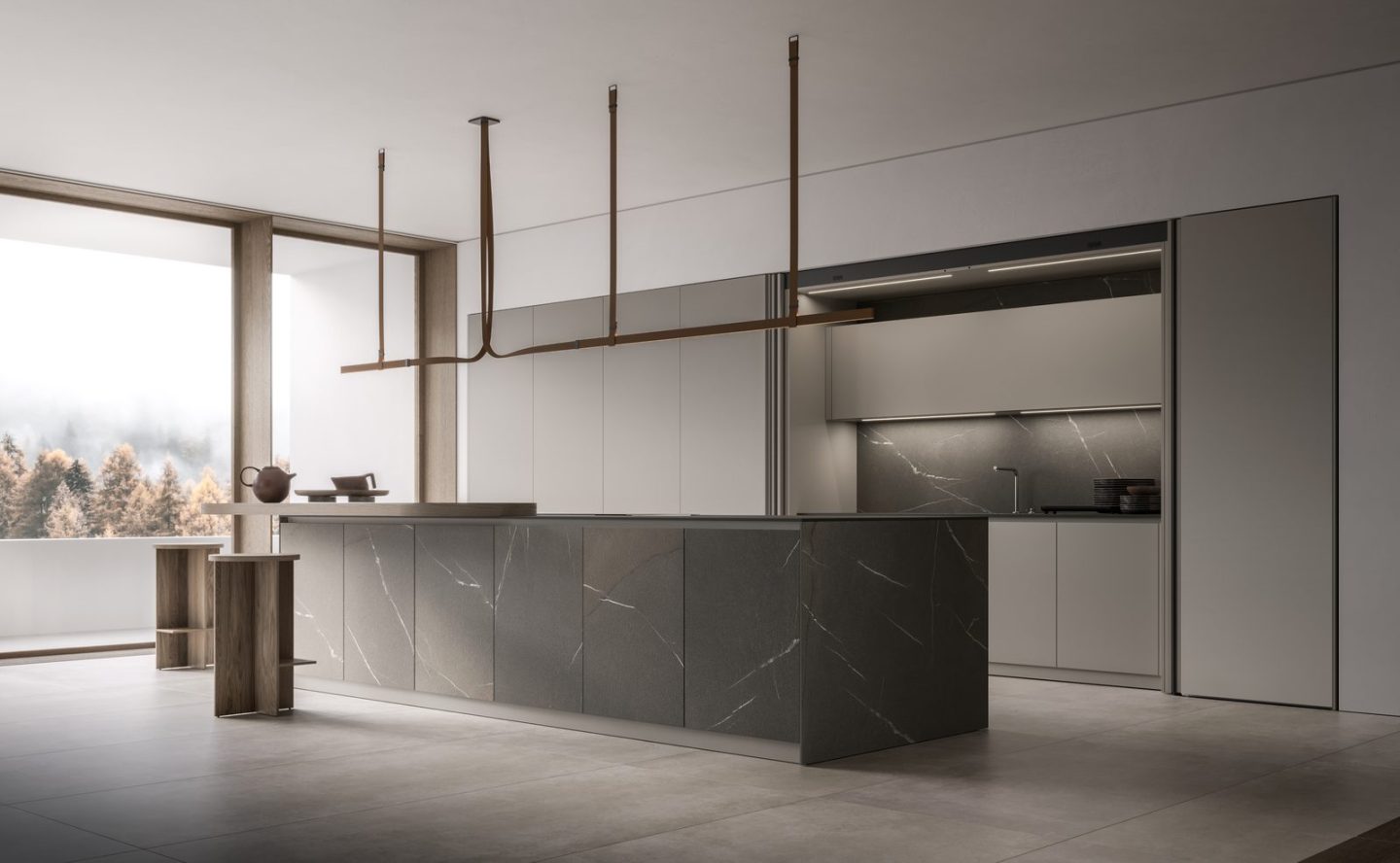
Here the kitchen does not want to look like a piece of furniture. It wants to read as a volume, as a continuation of the home's architecture. A few consistent decisions achieve this:
- Flat doors without a frame and without a visible handle, with a gola profile or push-to-open.
- Built-in appliances: dishwasher and fridge behind doors identical to the cabinets, ovens in tall columns.
- Matt surfaces, such as matt lacquer, Fenix or veneer, which do not shine and do not hold fingerprints as much as glossy ones.
- The same worktop continues up the wall as a splashback or down the sides of the island, so the surface is not broken.
- Storage behind doors: small appliances and sockets inside the cabinets, a worktop that stays largely clear.
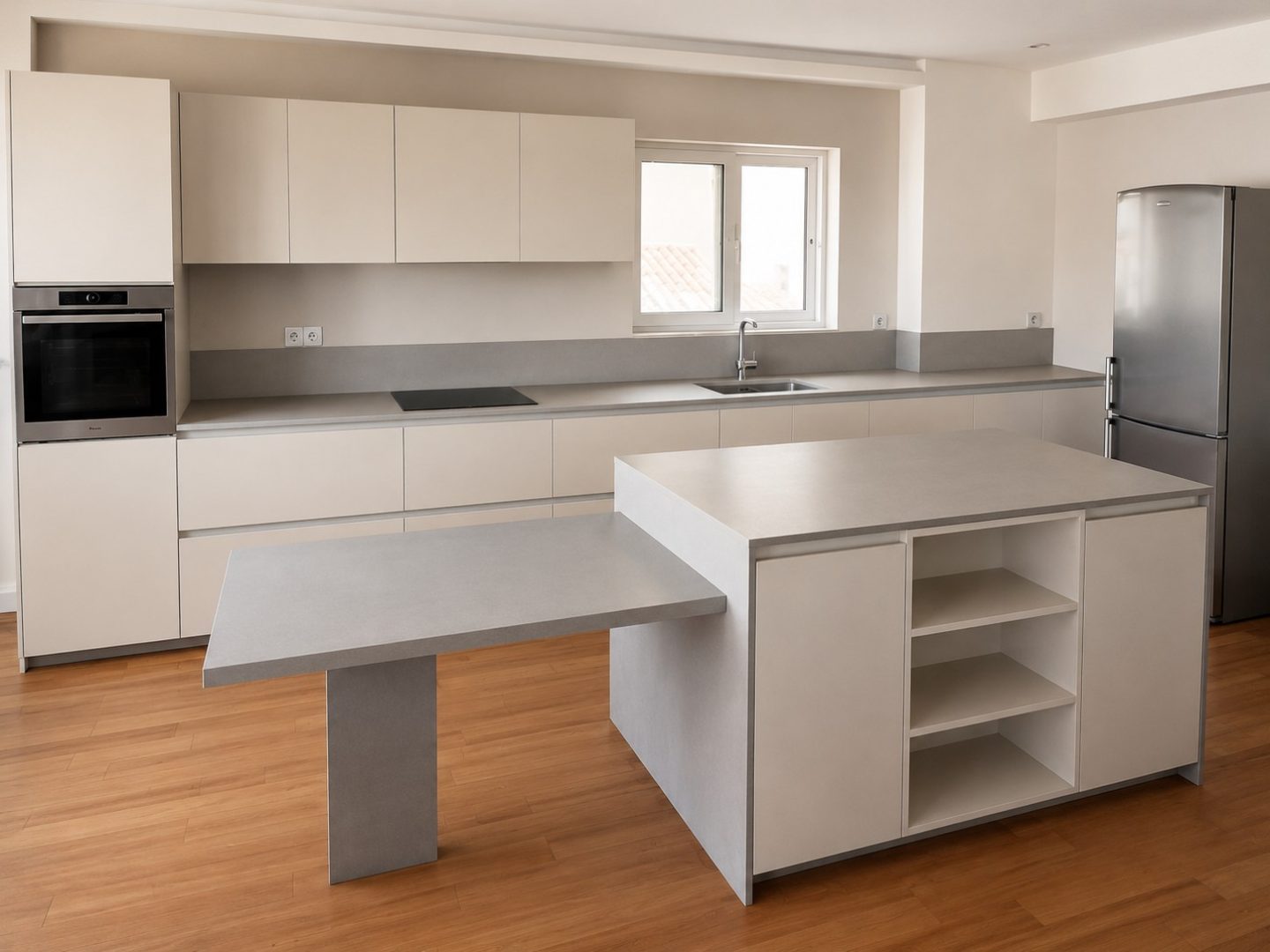
An example from our work: in Chalandri we designed, together with the owners, a Gentili Time with flat, handleless doors in matt Cappuccino lacquer. The Caesarstone Rugged Concrete quartz covers the worktop, rises high up the wall and runs down the sides of the island. The oven sits in a tall column, the dishwasher is built in and the sink is under the window. See the whole project in Chalandri.
The ranges that speak this language
- Gentili Time: a programme with a flat door, a framed door and an aluminium-frame door, all at 22 mm. In our showroom you will see it set up handleless, in Fenix Nero.
- Febal Casa Origina: a range with seven door programmes on the same carcase, from an aluminium profile to a fluted door. In the showroom there is an Origina island without handles, in fluted opaque glass.
- GF Interiors Flat: eight front versions, from melamine to veneer and metallic lacquer, all on the same gola.
- Pedini Materika: the 30° bevelled cut on the door front is the signature of the range, in Fenix, lacquer, metal, oak veneer or gres.
Before you decide between gola and push-to-open, read our guide to handleless kitchens.
Tuscan kitchen: the kitchen that shows its materials
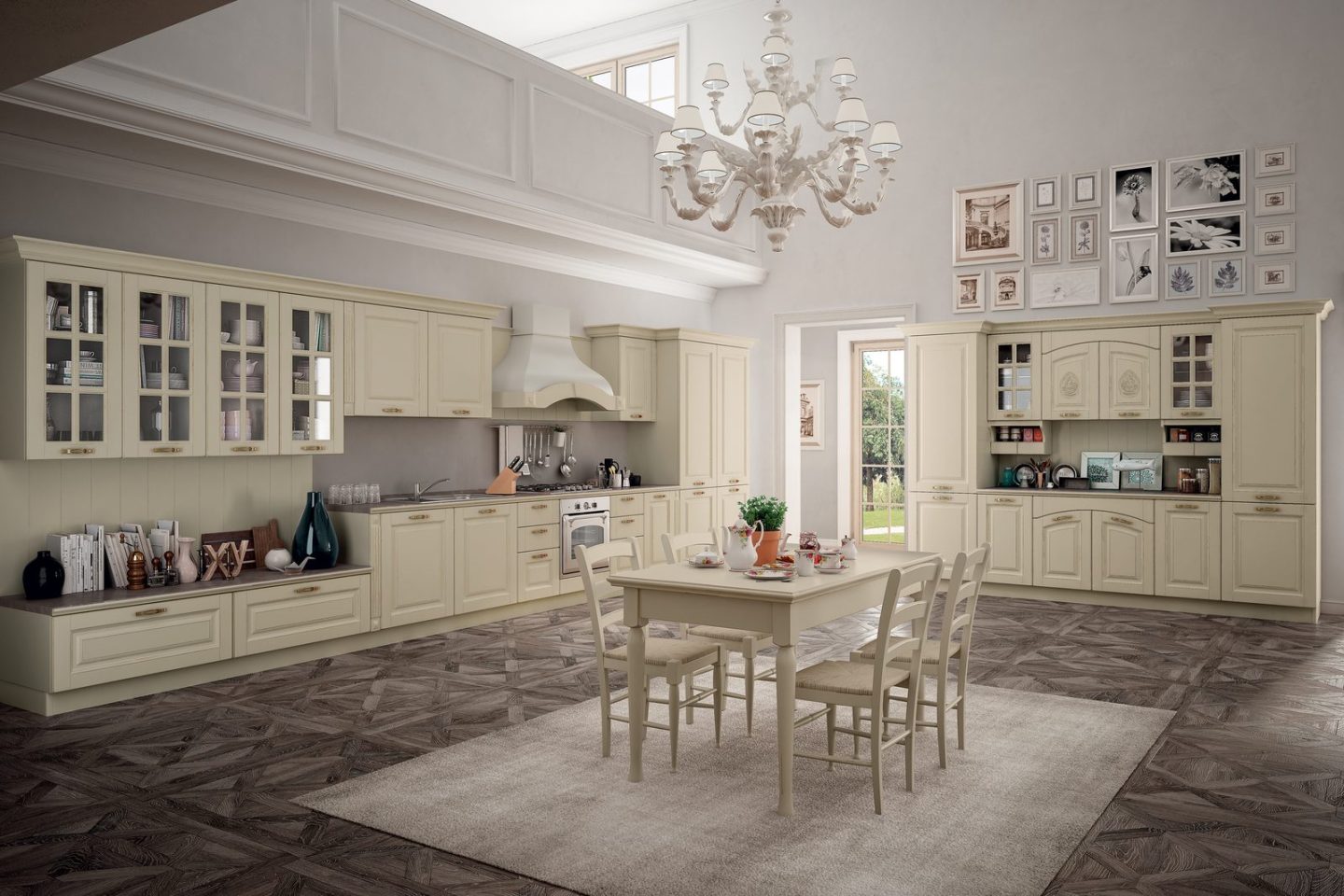
The Tuscan kitchen starts from the rural homes of central Italy: thick walls, wooden beams, stone, warm light. There the kitchen was the heart of the home and it showed. Today we keep that spirit with furniture made with precision:
- Framed doors and a relief panel, in wood or in patinated lacquer.
- Earthy colours: ochre, terracotta, sand, walnut, with a sage green or a deep blue as an accent.
- A worktop in a matt stone texture, without gloss.
- Handles and knobs with an aged finish, in bronze, copper or iron tones.
- The extractor hood as a focal point, framed or chimney-style, together with glass-front cabinets and open shelves for what you want to show.
A caution we mention in every conversation: when ageing effects and decorative details are overdone, the kitchen slides towards country or shabby chic. The Tuscan version keeps the lines clean and lets the material do the work.
The ranges that suit
- Febal Casa Sinfonia: a frame in solid alder with veneer on the panel, an ageing patina and handles in an aged finish, in shades such as Siena scuro and Grigio Dorian anticato. Sinfonia is set up in our showroom.
- Sira Cucine Sofia: 24 mm solid chestnut with a solid panel, in eleven finishes, from Noce antico to patina lacquer in Creta or Celeste cielo, and glass-front cabinets with lattice glazing. We present it to you with material samples and catalogues.
- Gentili Romantica: a frame in solid ash around a relief panel, in décapé shades. It, too, is set up in the showroom. In the same family, the Gentili Village offers slatted doors and glass-front cabinets with lattice glazing.
- Scandola Tabià: for a more rustic version, a door in 2.5 cm solid spruce. In the «Stile rustico» composition it is combined with a piasentina stone worktop and a chimney-style extractor hood.
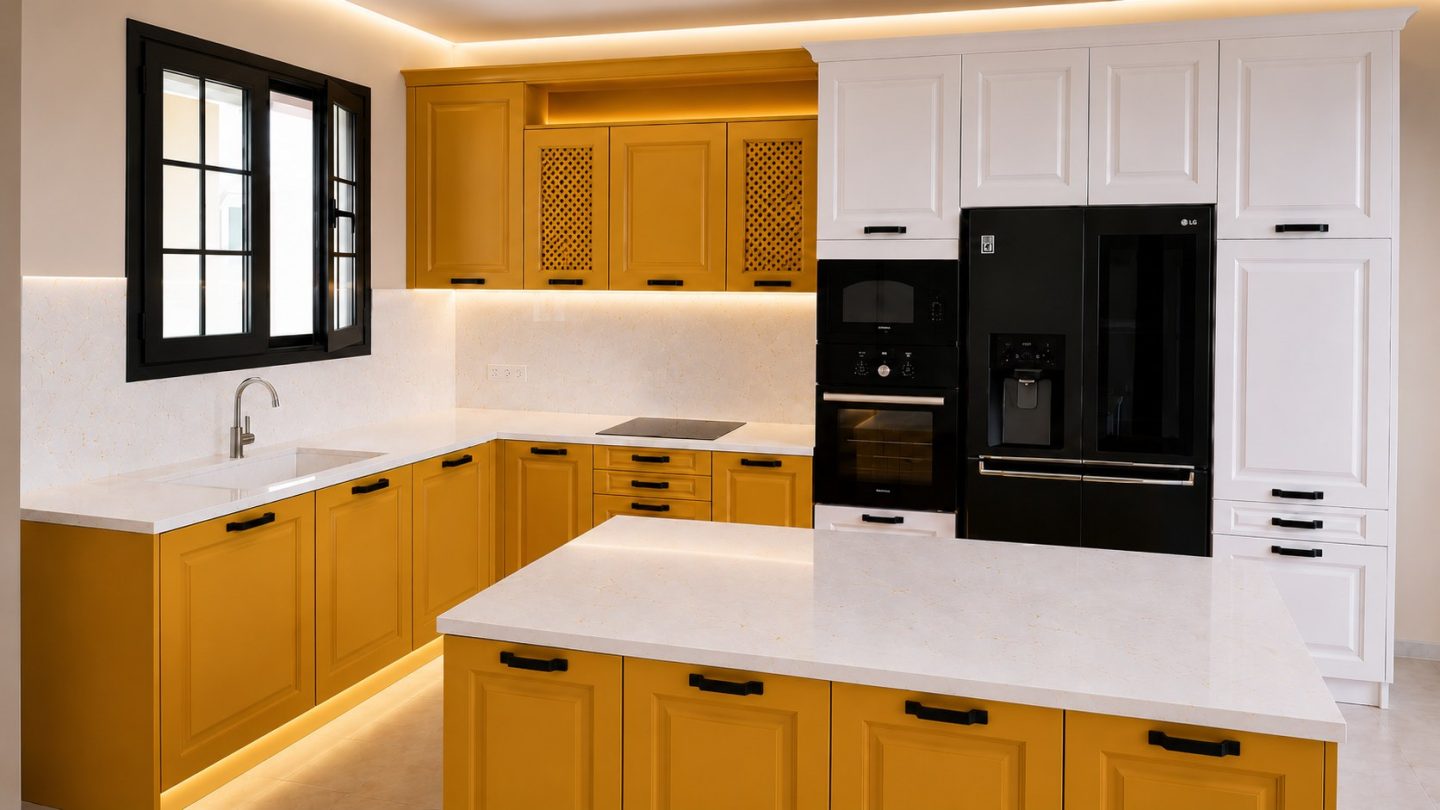
The Tuscan palette does not always need dark wood. In Piraeus we designed a two-colour Gentili Romantica: ochre lacquer on the base units and the island, white columns around the appliances, a white quartz worktop and black knobs. The ochre brings warmth, the white keeps the kitchen bright. See the project in Piraeus.
Side by side: what changes with each decision
| Decision | Minimalist | Tuscan |
|---|---|---|
| Door | Flat, no frame | Frame with relief panel |
| Opening | Gola or push | Handles and knobs with an aged finish |
| Surface | Matt lacquer, Fenix, veneer | Wood, patinated lacquer or décapé |
| Colours | White, grey, beige, black | Ochre, terracotta, sand, walnut, green |
| Worktop | Slim, continues up the splashback or onto the island | Matt stone or stone-effect |
| Appliances | Built-in, behind doors | Oven and extractor hood in the foreground |
| Storage | Everything behind doors | Glass-front cabinets and open shelves |
| Everyday life | Needs a tidy worktop | The patina hides the small marks of use |
Which one suits your home
There is no right answer. There is the one that suits your space and your life. These are the questions we ask at the first appointment:
- Is the kitchen open to the living room? The minimalist kitchen disappears into the space, while the Tuscan becomes the strongest piece of furniture in the home. Both work, as long as it is a conscious choice.
- What does the home already have? Beams, stone, arches or a country house naturally suit the Tuscan version. An apartment with large openings and clean lines suits the minimalist one more easily.
- How many things stay out? If you like to see utensils and jars, the Tuscan kitchen embraces them. If visual clutter tires you, the minimalist one closes them away behind doors.
- How do you cook? A range cooker with character goes with the Tuscan atmosphere. In the minimalist kitchen, hob and ovens are built in and are almost invisible.
The third way: minimalist lines, warm materials
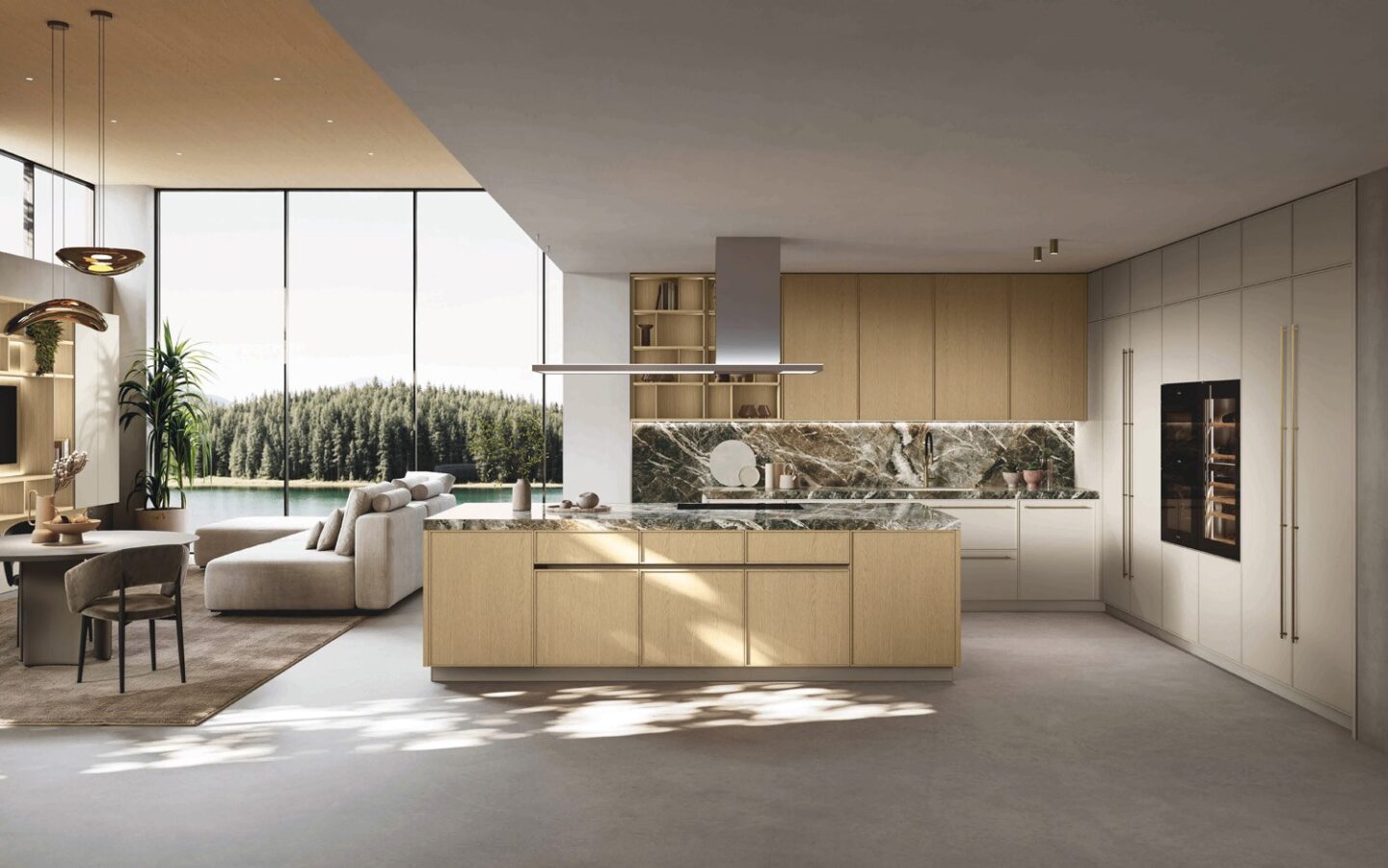
Many of the kitchens we design today do not pick a side. They keep the structure of minimalism, meaning flat doors, hidden storage and quiet lines, and borrow from Tuscany the materials and colours: wood with visible grain, stone, warm neutrals. The Cappuccino in Chalandri is one such example. Compositions in the same spirit include the Febal Modula in Grigio Caldo with Terracotta, the Origina in Bianco Neve with Terracotta and the GF Interiors Skinny, with a slim frame in solid oak, a front just 1 cm thick and a porcelain worktop with a stone look.
Worktops and appliances: where the style is decided
- Worktop. In the minimalist kitchen we want a slim thickness and continuity, the same worktop on the splashback and the island. In the Tuscan, a matt stone texture and a bolder thickness. In both cases we choose together between quartz and porcelain Caesarstone or sintered stone Ascale. We explain their differences in our guide to kitchen worktops.
- Appliances. For the minimalist kitchen, built-in appliances suit well, such as those from Miele, which disappear into the columns. For the Tuscan, the Bertazzoni, an Italian family company since 1882, has the Heritage series with a traditional look and range cookers in the Professional and Master series, in colours such as Arancio and Giallo. It also has the Modern Series in glass and steel, for the plainer version.
How we design it with you
You do not choose a style from a photograph. We build it together, step by step: visit, design, moodboard, quotation, installation, after-sales. In the moodboard we put doors, worktop, colours and handles side by side, so you can see your future home before you invest. In our showroom you will find both languages: the handleless Gentili Time and the Febal Origina island, as well as the Febal Sinfonia and the Gentili Romantica. For more ideas, see the classic kitchens and all the ranges in our collections.
Frequently asked questions
What is the basic difference between a minimalist and a Tuscan kitchen?
The minimalist kitchen hides: flat doors without handles, built-in appliances, matt surfaces and a clear worktop. The Tuscan kitchen shows: wood or patinated lacquer, framed doors, earthy colours, stone and handles with character.
Which Italian ranges suit a Tuscan kitchen?
From the houses we curate, Febal Casa Sinfonia, Sira Cucine Sofia, Gentili Romantica and Gentili Village. For a more rustic version, Scandola Tabià.
Which ranges suit a minimalist kitchen?
Gentili Time, Febal Casa Origina, GF Interiors Flat and Pedini Materika, with gola or flat fronts in matt finishes.
Can I combine the two styles?
Yes, and we often suggest it: minimalist lines with warm materials, such as matt lacquer in an earthy shade, wood with visible grain and a worktop with a stone texture.
Can I see such kitchens in person?
Yes. In our showroom in Neo Psychiko the handleless Gentili Time, a Febal Origina island, the Febal Sinfonia and the Gentili Romantica are set up. We present the other ranges to you with the houses' catalogues and photographs, applied to your own layout.
Haven't decided yet? Bring us the images you like and the floor plan of your space. We design the kitchen with you, and often the whole home. Book an appointment at our showroom, 267 Mesogeion Avenue, Neo Psychiko, or call us on +30 210 674 8332.
Shall we design it together?
Come to our showroom in Neo Psychiko — we design and cost your kitchen together. The 3D design for the presentation is free.
Book an appointment267 Mesogeion Avenue, Neo Psychiko, Athens · +30 210 674 8332